PHAREA performs numerical simulations to meet its clients’ needs. The numerical simulations conducted apply to mechanics in general and more specifically to structural mechanics, fluid mechanics, and heat transfer.
The study presented in the example below was established as part of an expert assessment regarding the weld failure of a tube sheet.
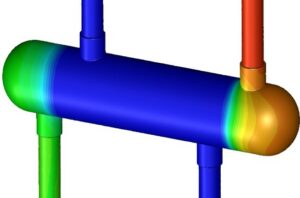
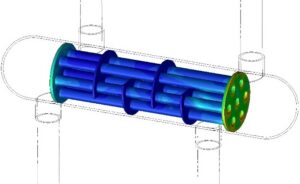
The heat exchanger illustrated in Figure 1 is a common application case—often even counter-current—where thermal performance and thermomechanical resistance can be easily represented through numerical simulation and multiphysics coupling.
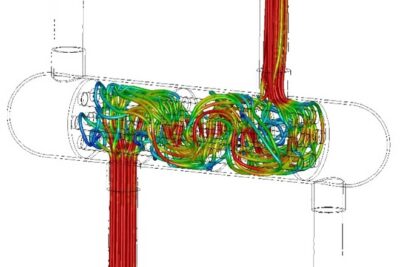
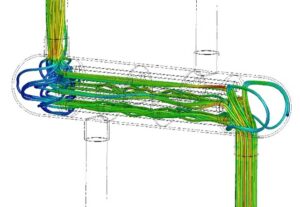
An initial Computational Fluid Dynamics (CFD) simulation is conducted to numerically solve, using the finite volume method, the flows and heat exchanges in order to determine the temperature in the fluids and solids of the exchanger. The CFD analysis illustrates flow velocities and trajectories (Figure 1 and Figure 2). It verifies the pressure drops of the two heat-transfer flows and the convective exchange coefficients on the exchange walls.
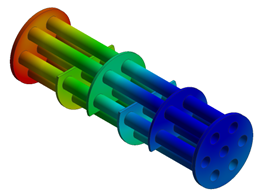
The temperature field in the solids (Figure 3 and Figure 4) resulting from the CFD simulation is then imported into the Finite Element Method (FEM) structural mechanics analysis.
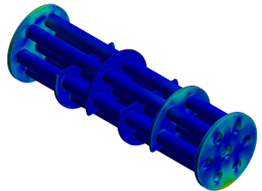
In structural mechanics (FEM), a representative temperature field is used to describe the deformations and stresses in the solids constituting the exchanger (Figure 5 and Figure 6).
The study conducted can involve several types of mechanical analysis depending on the nature of the material properties, whether linear, bilinear, or multilinear.